
- Blogs
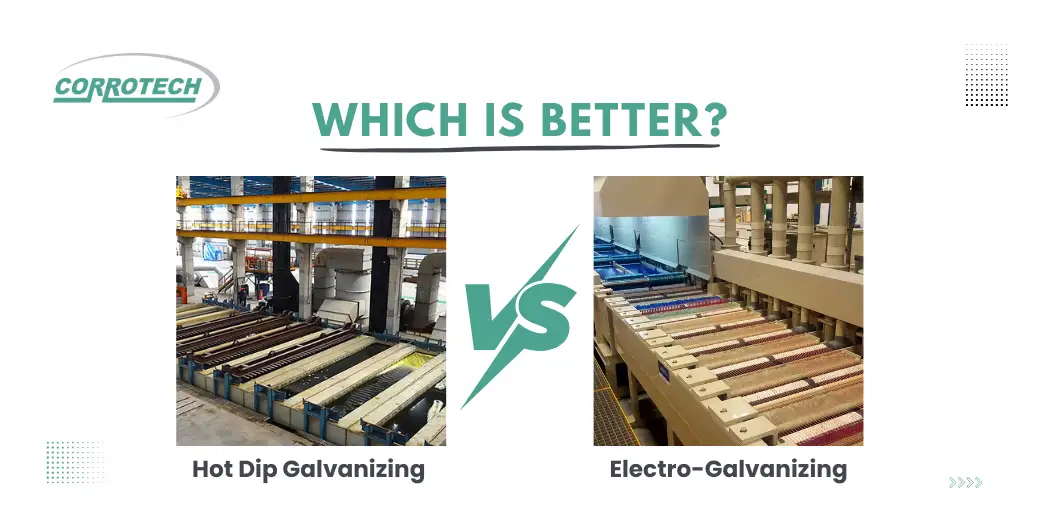
This is a protection for steel from corrosion in industries like infrastructure, automotive, fabrication, and heavy engineering. Among the usage of zinc coating, Hot Dip Galvanizing and Electro-Galvanizing are considered two of the most common usages. While both protect steel from a life span perspective, there are overwhelming differences in techniques, coating quality, durability, and its performance altogether.
In this detailed guide, we examine the difference between hot dip and electro galvanizing, offer a clear galvanizing process comparison, and explain why industries often prefer hot dip galvanizing for long-term protection.
What is Hot Dip Galvanizing (HDG)? Process, Benefits & Uses
The hot dip galvanizing process involves dipping steel components in a bath of molten zinc at around 450°C. This reaction produces multiple, tightly adherent metallurgical layers which are very resistant to corrosion.
A modern Hot Dip Galvanizing Plant is specially designed for handling large volumes, maintaining uniform coatings, and providing long-lasting protection under the most adverse environmental conditions.
Key Benefits
- A thick, durable coating
- Excellent corrosion resistance
- Long service life (30–70 years depending on environment)
- Suitable for structures located outdoors and heavy-duty applications
- Self-healing ability for small scratches through the sacrificial action of zinc
What is Electro-Galvanizing (EG)?
Electro-galvanizing is a process that involves steel passing through an electrolytic zinc salt solution, where an applied electrical current deposits a thin layer of zinc on the surface.
It produces a smoother, more cosmetically appealing surface and is suitable for automotive parts, appliances, and electronics.
Key Benefits
- Smooth shiny finish
- Thin and uniform coating
- Ideal for small components requiring an aesthetic appearance
- Does not involve high temperatures.
- Galvanizing Process Comparison: Hot Dip vs Electro-Galvanizing
Hot Dip vs Electro-Galvanizing: Detailed Comparison
Feature | Hot Dip Galvanizing (HDG) | Electro-Galvanizing (EG) |
Zinc Bonding Method | Zinc metallurgically bonds with steel, forming multiple alloy layers | Zinc is electroplated as a thin, uniform top layer |
Service Life Expectancy | 30–70 years depending on environment | 5–15 years depending on usage |
Impact & Abrasion Resistance | Excellent,thick alloy layers resist scratches and mechanical damage | Moderate,thin coating gets scratched easily |
Heat & Weather Tolerance | Performs well in coastal, industrial, and high-humidity zones | Designed mainly for controlled indoor conditions |
Environmental Exposure Suitability | Suitable for harsh outdoor environments | Best for clean, dry indoor applications |
Maintenance Requirement | Very low or none once applied | Requires periodic inspection and touch-ups |
HDG vs EG: Coating Thickness Difference
1. Coating Thickness
Hot Dip Galvanizing: 45–120 microns
Electro-Galvanizing: 5–25 microns
Hot dip provides a considerably thicker protective layer, which ensures far better long-term corrosion resistance.
2. Corrosion Resistance
A thicker coating creates a stronger barrier.
Hot Dip Galvanizing: Excellent in extreme environments, such as marine, industrial, or humid conditions.
Galvanizing Electro: Poor corrosion resistance; best for indoor use.
Want to establish a high-capacity Hot Dip Galvanizing Plant or upgrade the existing one?
Arvind Corrotech Ltd offers world-class galvanizing equipment, process expertise, and turnkey solutions according to your industrial needs. Contact us today for expert guidance and robust galvanizing technology!
3. Bond Strength
Hot Dip Galvanizing: transmission towers, guardrails, steel structures, pipelines, cable trays.
Electro-Galvanizing: Electronic devices, automotive parts, lightweight sheet metals.
4. Application Areas
Hot Dip Galvanizing: transmission towers, guardrails, steel structures, pipelines, cable trays.
Electro-Galvanizing: Electronic devices, automotive parts, lightweight sheet metals
5. Cost & Lifespan
Hot Dip: Slightly more expensive initially, long-term costs are considerably lower because it requires low maintenance.
Galvanizing-Electro: Lower initial cost; however, it has a shorter life span, requiring more replacements.
Which Galvanizing Method Is Better? (HDG or EG?)
It all depends on the application.
If your priority is maximum corrosion resistance, long service life, and protection in harsh environments, hot dip galvanizing is the superior solution.
For smooth, aesthetic finishes on indoor or light-weight components, electro-galvanizing works quite well.
However, several industries prefer investing in a high-quality Hot Dip Galvanizing Plant for structural reliability, infrastructure durability, and industrial-grade performance.
While both zinc coating methods have their benefits, hot dip galvanizing is without any doubt far superior in durability, protection, and lifecycle value. It forms much stronger coatings and offers excellent corrosion resistance over a long, reliable period; hence, its wide use in heavy-duty applications globally. Arvind Corrotech Ltd remains one of the leading Galvanizing Plant manufacturers in India, with continued deliveries of top-notch galvanizing solutions that will not only improve performance but also guarantee long life in the harshest conditions.
Recent Posts
- Galvanizing Furnace Fuel: LPG vs Natural Gas vs Diesel
- Pickling Process in Steel Plants
- Different Types of Chemical Storage Tanks: A Complete Selection Guide for Industrial Buyers
- Galvanizing Plant Setup Guide: From Planning to Installation
- Choose Arvind Corrotech Limited Among HDPE Storage Tank Manufacturers
Brochure
View our 2019 financial prospectus brochure for an easy to read guide on all of the services offer.
DownloadLet's help you!
Quisque venenatis dolor nec eros elementum, non pulvinar lectus dictum. Sed sagittis felis …
Inquiry Now