
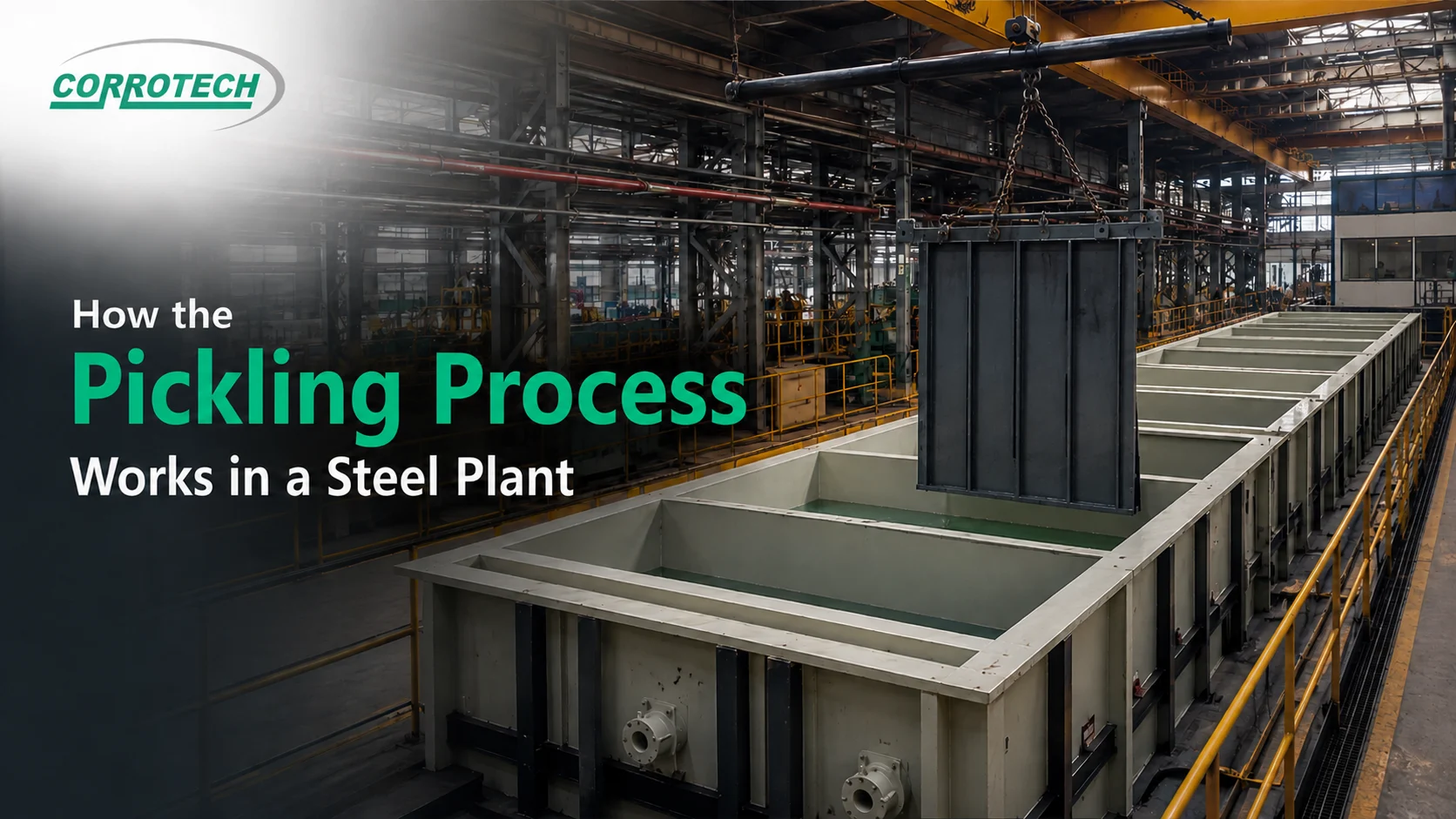
If you’ve spent any time around a steel mill, you already know steel doesn’t roll out of a furnace looking finished. Hot-rolled and cold-rolled coils come out carrying a layer of scale, rust, and oxide on the surface, and that layer needs to be stripped off before the steel can be welded, coated, galvanized, or shaped into anything usable. This is where the pickling tank plays a crucial role in steel plant operations, making the pickling process effective and reliable
For engineers and plant managers, pickling isn’t just some cleaning step squeezed in between rolling and finishing. It has a direct bearing on surface quality, how smoothly the steel moves through downstream processing, and whether a mill can consistently hit customer specs. In this article, we’ll break down what pickling actually does, how it’s carried out on the floor, and which controls really matter.
What Is Pickling Process, and Why Does Steel Need It
So, what is pickling process in plain terms? It’s a chemical treatment that strips iron oxide scale, rust, and other surface contaminants off steel using an acid bath. This scale builds up naturally when hot steel reacts with oxygen while it’s being rolled and cooled. If it’s left on, it messes with coating adhesion, creates an uneven finish, and often leads to defects further down the line during galvanizing or cold rolling.
Think of it a bit like prepping a wall before you paint it. You wouldn’t paint over flaking plaster and expect a good result. Steel works the same way – any coating, plating, or forming step done over scale just won’t bond properly, or it’ll trap contaminants right under the surface.
The pickling process in steel industry operations has stuck around for decades simply because mechanical cleaning alone – think shot blasting – usually can’t get the surface clean enough for precision work. Acid pickling gets into surface irregularities that mechanical methods just can’t reach.
How the Pickling Process Works in a Steel Plant
The steel pickling process generally moves through a set sequence of stages – each one built to prep the coil for the acid bath, treat the surface, and then protect it before it heads to the next stage of production.
1. Pre-Cleaning and Degreasing
Before the acid even touches the steel, the coil goes through degreasing. Oils, lubricants, and leftover residue from rolling get cleaned off using alkaline cleaners or hot water sprays. Skip this step, and the acid bath simply won’t work as well – you’ll end up with patchy, inconsistent scale removal.
2. Acid Bath Treatment
This is really the heart of the pickling treatment for steel. The coil runs through a series of tanks filled with acid solution – usually hydrochloric acid for carbon steel, or a nitric-hydrofluoric acid mix for stainless steel. The acid breaks down the oxide layer through a controlled reaction, lifting the scale off without harming the steel underneath.
Most plants run a continuous pickling line, where the coil unwinds and passes through multiple acid tanks one after another. Each tank chips away at progressively finer scale, so by the time the coil comes out the other end, the surface is clean and even.
3. Rinsing
Once the acid has finished its job, the steel needs a thorough rinse to wash off any leftover acid and dissolved iron salts. This usually happens across several stages with fresh water, often set up in a counter-flow arrangement so the plant saves water while still getting a neutral surface.
4. Drying and Surface Protection
After rinsing, the coil gets dried and, in a lot of cases, gets a temporary oil film or passivation layer to stop flash rust from setting in before it reaches the next stage.
Temperature Control During Steel Pickling
Temperature control during steel pickling is far from a minor detail – it’s one of the variables that really decides how well the whole process performs. Acid gets more reactive as temperature rises, so most plants keep their pickling baths within a defined range depending on the acid type in use. Hydrochloric acid baths for carbon steel typically run between 60°C and 90°C, while sulfuric acid baths sometimes run hotter, up to around 100°C, since sulfuric acid needs more heat to work effectively. Stainless steel lines using nitric-hydrofluoric acid mixes tend to stay closer to the lower end of that range, since these acids are more aggressive to begin with.
Run the bath too cold, and scale removal slows right down, leaving you with under-pickled surfaces that still hold onto residual oxide. Run it too hot, and the acid starts eating into the base metal itself – a problem known as over-pickling – which roughens the surface and burns through acid needlessly. Most continuous lines rely on automated temperature monitoring and heating systems to hold that tight window, since even small swings in temperature can throw off line speed and quality.
Time Duration for Pickling Steel
The time duration for pickling steel comes down to a handful of factors – scale thickness, acid concentration, bath temperature, and the steel grade in question. On a continuous pickling line, any given section of coil might only be exposed for a few minutes at a time, since it’s constantly moving through the tanks. In batch pickling setups, though, a coil or a set of parts might sit soaking in the acid bath anywhere from 15 to 45 minutes.
Thicker scale from hot rolling generally calls for longer exposure or a stronger acid concentration compared to lighter surface oxidation. Plants running a mix of steel grades often tweak dwell time and concentration batch by batch rather than sticking to one fixed setting across the board.
Common Pickling Techniques in Steel Manufacturing
Different mills lean on different pickling techniques in steel manufacturing depending on what they’re producing, how much throughput they need, and the steel grade involved.
Continuous pickling lines (CPL) are the go-to for high-volume hot-rolled coil processing. The coil keeps moving through the acid tanks without stopping, which makes this the efficient choice for large-scale carbon steel production.
Push-pull pickling lines run more like a batch process, and they tend to suit mills with lower volumes or a wider variety of product specs.
Electrolytic pickling brings an electric current into the mix to speed up the acid reaction, and it’s often used for stainless steel, where plain acid pickling alone would either take too long or need overly aggressive acid strength.
Each of these is really its own steel pickling method suited to a particular kind of production, and picking the right one usually comes down to volume, steel grade, and what infrastructure the plant already has in place.
Pickling as Part of Broader Metal Treatment Processes
Pickling doesn’t happen in a vacuum. It’s one piece of a much larger set of metal treatment processes that get steel ready for whatever it’s eventually used for. In a lot of plants, pickling lines feed straight into downstream operations like cold rolling, annealing, or galvanizing – so the surface quality coming out of pickling directly shapes how well those next steps go.
That’s exactly why pickling line design, chemical dosing, and rinsing efficiency get so much attention from process engineers. A weak link at the pickling stage tends to surface later on – as coating defects, adhesion failures, or coils getting rejected outright.
Common Mistakes to Avoid in Pickling Operations
A handful of recurring issues tend to trip up pickling line performance:
- Inconsistent acid concentration: letting acid strength drift without regular titration checks leads to scale removal that’s all over the place.
- Poor rinsing: skimping on rinsing leaves acid residue behind, which shows up later as surface staining or corrosion.
- Ignoring bath temperature drift: small temperature swings add up over a shift and start affecting output quality.
- Delayed acid regeneration or disposal: spent acid that doesn’t get managed properly weakens bath performance and can create environmental compliance headaches.
Most of these come down to staying on top of monitoring and keeping the pickling line’s chemical and mechanical systems on a regular maintenance schedule.
Why Getting Pickling Right Matters for Steel Plant Output
A well-run pickling process in steel plant operations lays the groundwork for everything that comes after – coating quality, forming consistency, and how the final product looks and performs. Plants that treat pickling as a precision process rather than just routine cleaning tend to see fewer rejections down the line and much steadier output across production runs.
Frequently Asked Questions
1. What acid is used for pickling steel?
For carbon steel, hydrochloric acid is the most common choice, since it works fast and doesn’t attack the base metal too aggressively. Stainless steel usually needs a stronger mix of nitric and hydrofluoric acid because its chromium content makes the oxide layer tougher to remove.
2. What is the difference between pickling and passivation?
Pickling removes scale, rust, and heat tint using a fairly aggressive acid treatment, and it does eat into a thin layer of the base metal. Passivation comes after pickling and uses a much milder acid to build up a protective chromium-oxide layer on the surface – it doesn’t strip material, it protects it. In short, pickling cleans, passivation protects.
3. How long does the pickling process take for steel?
It depends on the setup. On a continuous pickling line, a section of coil is only in contact with the acid for a few minutes at a time since the line keeps moving. In batch pickling, a coil might sit in the acid bath anywhere from 15 to 45 minutes, depending on scale thickness and acid strength.
4. What happens if steel is over-pickled or under-pickled?
Under-pickled steel still has traces of oxide left on the surface, which shows up later as coating or adhesion problems. Over-pickled steel has been left in the acid too long or at too high a temperature, so the acid starts attacking the base metal itself, leaving a rough, uneven surface and wasting acid in the process.
5. What is electrolytic pickling, and when is it used?
Electrolytic pickling uses an electric current to speed up the acid reaction. It’s mainly used for stainless steel, where standard acid pickling alone would either take too long or need acid concentrations aggressive enough to risk damaging the surface.