
A hot dip galvanizing plant is a long-term investment. Its size, layout and automation shape your output, coating quality, running costs and compliance for many years. A kettle too short for your longest beam, or fume extraction added as an afterthought, can limit the plant for its whole working life.
This guide is for business owners, engineers and investors planning a new plant or an expansion. It explains how the process works, what to weigh when you choose a plant, the main types of hot dip galvanizing equipment, what a galvanizing plant setup needs, and how to judge hot dip galvanizing plant cost over the plant’s life.
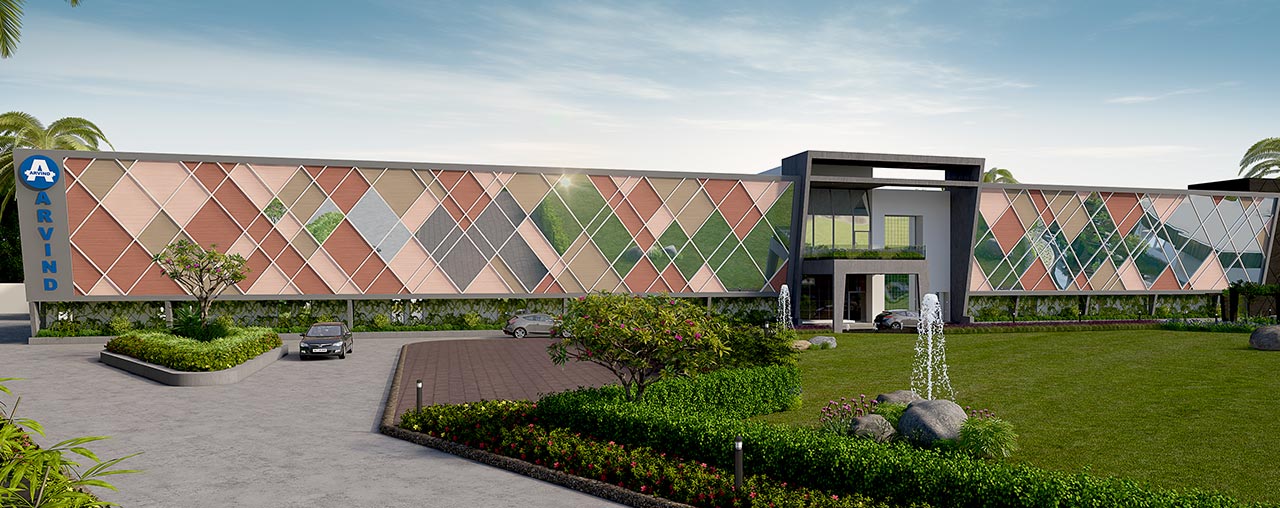
It is written by Arvind Corrotech, a galvanizing plant manufacturer in Ahmedabad, Gujarat, that designs and supplies turnkey plants. How to read the evidence: facts from standards bodies link to their source; Arvind’s own figures are labelled as company figures; advice is marked as guidance.
Understanding Hot Dip Galvanizing
Definition and process
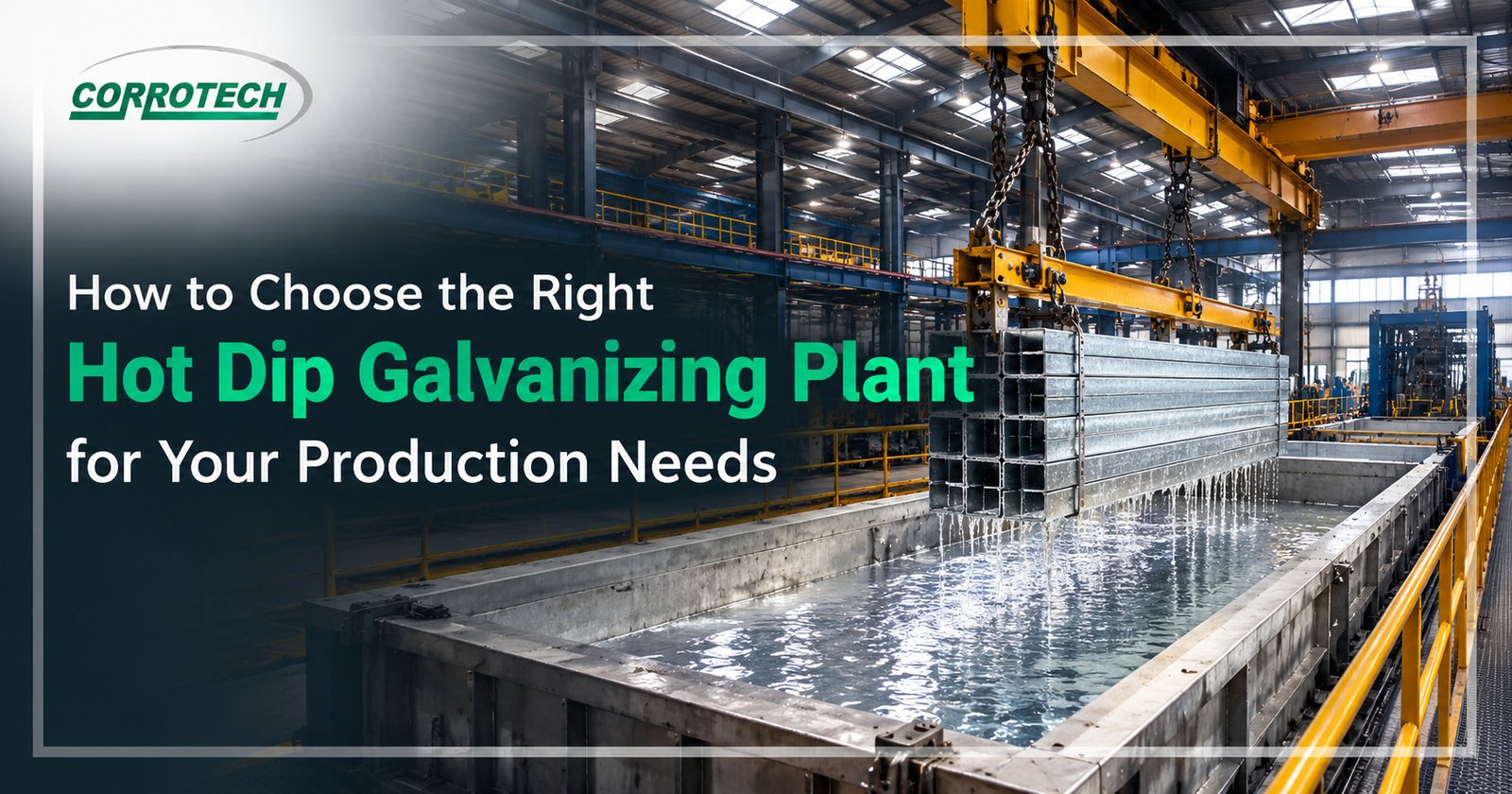
Hot dip galvanizing (HDG) is the process of dipping cleaned, fabricated steel or iron into molten zinc. According to the American Galvanizers Association (AGA), the bath must contain at least 98% pure zinc (as specified by ASTM B6) and is held at 435–455 °C (815–850 °F). While the steel is immersed, the zinc reacts with the iron to form a series of metallurgically bonded zinc-iron alloy layers. These are usually topped by a layer of pure zinc.
A typical batch hot dip galvanizing line runs in this order:
- Degreasing: a hot alkaline solution removes oil, grease and dirt.
- Rinsing.
- Pickling: dilute heated sulphuric acid or ambient hydrochloric acid removes mill scale and rust.
- Rinsing.
- Fluxing: a zinc ammonium chloride solution removes the last oxides and protects the surface until dipping.
- Drying: removes moisture, which helps prevent zinc splatter in the bath.
- Galvanizing: immersion in the zinc kettle.
- Quenching or passivation, then inspection.
Each stage needs its own tank, heating, fume control and lifting, so the design of the whole hot dip galvanizing line matters as much as any single machine. Ourstep-by-step guide to the hot dip galvanizing process covers each stage in more detail.
Benefits of hot dip galvanizing
These are established, sourced benefits:
- Long life: the AGA states that a galvanized coating generally corrodes at about 1/30 the rate of bare steel in the same environment.
- Complete coverage: because the steel is fully dipped, inside surfaces, corners and edges are coated, not just the outside.
- Built-in quality check: the AGA notes that zinc will not react with an unclean steel surface. Poor surface preparation therefore shows up as bare patches as soon as the steel leaves the bath.
- Clear standards: coatings are specified to ASTM A123/A123M for fabricated steel, ASTM A153 for hardware such as fasteners, and ISO 1461 internationally.
These benefits depend on a well-controlled process, which depends on the plant.
Key Factors to Consider When Choosing a Hot Dip Galvanizing Plant
Production capacity and scalability
Start with your work, not the catalogue. Before you contact any galvanizing plant manufacturer, write down:
- the tonnage you need to galvanize per day and per year, now and in five years;
- the longest, widest and heaviest piece you will dip;
- your product mix: structural steel, poles, pipes and tubes, wire, fasteners or small parts;
- whether you galvanize your own products or offer job-work galvanizing for others.
The zinc kettle is the most important sizing decision, because it fixes the largest item you can coat. Size it to your biggest products, then check it can meet your daily tonnage. Our article on choosing the right kettle size explains the trade-offs.
Plan for growth. A kettle is hard to enlarge, but spare building length, extendable crane rails and room for more tanks let you add capacity in stages.
Equipment types and technology
Two plants with the same kettle can perform very differently. When you compare quotes, check how each item is specified, not just whether it is listed:
- Kettle: steel grade, wall thickness and corner design. Arvind’s zinc kettles, for example, use low-silicon steel, radiused corners, 40, 50 or 60 mm walls, and ultrasonic and radiography testing.
- Furnace: burner type, fuel and controls. Arvind’s pulse fired high velocity furnace runs on gas (PNG/LPG), oil (LDO/HSD) or both, with PLC-based burner management.
- Tanks: material and lining for each chemical.
- Cranes: capacity and reach over every station.
Fuel choice affects running cost; see our comparison of LPG, natural gas and diesel for galvanizing furnaces.
Cost considerations
Budget for the whole project, not just the machinery. A realistic budget includes the equipment, pollution control, civil works, utilities, land and working capital, including the first charge of zinc. Compare quotes on the same scope: a low price that leaves out the effluent treatment plant, fume extraction or commissioning is not a saving. The cost section below gives published ranges.
Quality control measures
The AGA says coating thickness is the most important component in judging a galvanized coating’s quality, because time to first maintenance is directly proportional to it. Adherence, appearance and finish are the other key checks. Ask how the plant keeps results consistent:
- temperature control and recording in the kettle and pretreatment tanks;
- monitoring of acid and flux strength;
- repeatable dip and withdrawal times;
- a dedicated inspection area, with thickness gauges.
Then check the manufacturer’s own quality system. Arvind lists ISO 9001:2015 certification for the design, manufacturing and supply of hot dip galvanizing plants. Ask any supplier for a current certificate copy and its expiry date.
Manufacturer reputation and support
Galvanizing plants run hot, use acids and lift heavy loads, so experience matters. Ask each galvanizing plant manufacturer:
- How many plants of this type and size have you supplied?
- Can we visit, or speak to, an operating plant?
- Who will manage our project, and what galvanizing experience do they have?
- What training, spare parts, maintenance contracts and breakdown response do you offer after commissioning?
For reference, Arvind’s About Us page cites founders with more than 25 years of experience and a 10,000 square metre facility in Ahmedabad. Its clientele page lists more than 100 companies, and its services include maintenance contracts, spares, training and zinc kettle replacement. Treat any client list as a starting point and ask for references from projects like yours.
Types of Hot Dip Galvanizing Equipment
Overview of various equipment options
A complete hot dip galvanizing line is a set of linked systems. Arvind’s turnkey hot dip galvanizing plants include the following industrial galvanizing equipment:
| Stage | Equipment |
|---|---|
| Pretreatment | Degreasing, pickling, rinsing and flux tanks; an encapsulated pretreatment room; flux heating and flux filtration |
| Drying | Re-circulating air dryer |
| Galvanizing | Pulse fired furnace, zinc kettle and zinc fume enclosure |
| After the bath | Quench and passivation tanks |
| Pollution control | Acid fume extraction, zinc fume extraction and an effluent treatment plant |
| Handling and storage | Cranes, conveyors and trolleys; acid storage tanks |
The product you coat also shapes the line. Arvind lists separate plant types for structural steel, pipes, tubes, wire, fasteners and small parts. Long structural members need a long kettle and cranes that handle them safely. Small parts are often galvanized in baskets and spun in a centrifuge to remove excess zinc.
Manual vs. automatic galvanizing plants
After kettle size, the biggest choice is how material moves. Arvind’s material handling systems range from manually operated systems and monorail cranes, through semi-automatic crane systems, to fully automatic crane systems with hydraulic loading stations, chain conveyors and transfer trolleys.
| Manual / monorail | Semi-automatic | Fully automatic galvanizing plant | |
|---|---|---|---|
| How material moves | Operators control hoists for every move | Some movements between tanks are automated | Automated cranes and conveyors run the sequence |
| Process control | Depends on operator skill | Partly recorded | PLC control, with data logged for each load |
| Upfront cost | Lowest | Medium | Highest |
| Labour need | Highest | Medium | Lowest |
| Typically suits | Lower volumes, very mixed jobs | Growing volumes | High, steady volumes of similar products |
An automatic galvanizing plant adds PLC control panels, supervisory control and remote access. It can also record production data in a manufacturing execution system (MES), as on Arvind’s plant automationpage. Arvind says its fully automatic solutions can reduce the need for manpower by up to 90%. That is a company figure, so ask how it would apply to your plant and product mix.
Guidance: you don’t have to choose all or nothing. Many buyers automate what affects quality and safety first, such as crane movements over the kettle and temperature control, and add more automation later.
Hot Dip Galvanizing Plant Setup Requirements
Space and layout considerations
A good galvanizing plant setup moves steel in one direction, from receiving and jigging, through pretreatment, drying and the kettle, to quenching, inspection and dispatch, without loads crossing back. Plan for:
- Land and building: Arvind’s own galvanizing plant setup guide gives 2,000–3,000 square metres for a small plant with a 4-metre kettle. It gives 8,000 square metres or more for a larger structural plant (company figures).
- Height: enough clearance to lift your tallest pieces over the tanks.
- Floor loading: the kettle, acid tanks and crane gantry put heavy point loads on the floor.
- Crane reach: every station within reach, with capacity matched to your heaviest load plus a safety margin.
- Expansion space: for a longer line or extra tanks later.
Our project design service covers complete plant design, layout and equipment foundation designs.
Safety and environmental regulations
With acids, molten zinc at around 450 °C and heavy loads, safety and environmental systems belong in the design from day one:
- Approvals: Arvind’s setup guide lists State Pollution Control Board consent, a factory licence, a fire NOC and hazardous waste authorisation. Apply before construction, as conditions shape the design.
- Fumes: pickling tanks give off acid fumes, and dipping fluxed steel produces zinc fumes. Both need capture at source: an encapsulated pickling area, kettle enclosures and extraction systems.
- Wastewater: an effluent treatment plant treats acidic, zinc-bearing water before discharge.
- Acid storage: bunded storage with spill containment.
- Worker safety: guarding, safe access around the kettle, protective equipment and training.
Retrofitting them later usually costs more and disrupts production.
Maintenance and operational efficiencies
Running costs are largely decided at the design stage. Ask how your industrial galvanizing equipment will be maintained and how it keeps consumption down:
- Zinc use: an even bath temperature and good dross management help control zinc consumption. Arvind says its high-velocity furnace keeps the zinc temperature uniform, which lowers zinc consumption and dross formation (company claim).
- Kettle life: Arvind says its kettles can last 9 to 10 years even at high production rates, if they are operated within the recommended parameters (company claim). Ask any supplier what kettle life it expects and on what conditions.
- Chemistry upkeep: flux filtration and heating keep the flux in condition for longer.
- Spares and service: confirm lead times for burners, pumps and crane parts, and who services them.
Cost Analysis of Hot Dip Galvanizing Plants
Initial investment vs. long-term savings
There is no fixed price, because capacity, kettle size, site and automation all vary. As a reference point, Arvind’s setup guide (June 2026) publishes these ranges for India:
| Item | Published range (Arvind, June 2026) |
|---|---|
| Machinery for a basic to semi-automatic plant (kettle, furnace, tanks, crane) | From about ₹1 crore to ₹3 crore |
| Complete operational plant (plus civil works, ETP, land and working capital) | About ₹1.5 crore to ₹6 crore or more |
These are indicative ranges, not a quote. A detailed project report for your kettle size and site is the right basis for a real budget.
The cheapest plant to buy is not always the cheapest to run. Over its life, these usually matter more than a small price difference:
- fuel efficiency of the furnace;
- zinc consumption and dross;
- acid and flux use;
- kettle replacement intervals;
- labour.
Automation, a better furnace or a well-built kettle raise the initial investment but can lower these costs. Ask suppliers to show expected savings for your tonnage; treat any figure without stated assumptions as a sales estimate.
Factors influencing overall cost
- Capacity and kettle size: more zinc, a bigger furnace and a bigger building.
- Product type: structural, pipe, wire and small-parts lines differ.
- Automation level: manual, semi-automatic or fully automatic.
- Fuel and heating: affects capital and running cost.
- Environmental scope: ETP and fume extraction size.
- Location: land, construction and utility charges vary by region.
Conclusion
The right hot dip galvanizing plant matches your products, volumes and budget, today and as you grow. Size the kettle to your real products, compare how each piece of hot dip galvanizing equipment is specified, match automation to your volumes, build in safety and environmental systems from the start, and judge cost over the plant’s life. Above all, choose a galvanizing plant manufacturer with proven design, manufacturing and after-sales support.
Arvind Corrotech offers a turnkey route, from plant design and equipment manufacture to installation, commissioning and long-term support.
Planning a new galvanizing plant or upgrading an existing line? Contact Arvind Corrotech with your product sizes and target tonnage, and our team will help you plan the right plant.
Frequently Asked Questions
What is a hot dip galvanizing plant?
A hot dip galvanizing plant cleans steel or iron and dips it in molten zinc to protect it from corrosion. It includes pretreatment tanks, a dryer, a furnace-heated zinc kettle, quench tanks, cranes, and fume and effluent treatment systems.
How much does a hot dip galvanizing plant cost in India?
Arvind Corrotech’s June 2026 setup guide puts machinery for a basic to semi-automatic plant at about ₹1 crore to ₹3 crore. It puts a complete operational plant at about ₹1.5 crore to ₹6 crore or more. The final hot dip galvanizing plant cost depends on capacity, kettle size, automation and location.
Is an automatic galvanizing plant worth the extra cost?
It depends on your volumes and product mix. Automation suits high, steady volumes of similar products, where it gives steadier dip times, lower labour needs and better production records. For low or very mixed volumes, a semi-automatic line is often the better balance.
How do I choose the right zinc kettle size?
Size the kettle to the longest, widest and heaviest items you plan to galvanize, then check that it can meet your daily tonnage. A kettle that is too small limits the work you can accept and is costly to change later.
What should a galvanizing plant quotation include?
Every item should be specified: the kettle steel and thickness, the furnace and fuel, tank materials, crane capacity, fume extraction and the ETP. The quote should also say whether design, installation, commissioning, training and spare parts are included.
What are the tips for selecting the right galvanizing plant manufacturer?
Choose one that designs and builds its own equipment, can show you operating plants like yours, holds current certifications, quotes the full scope, and confirms training, spares and kettle replacement in writing.