
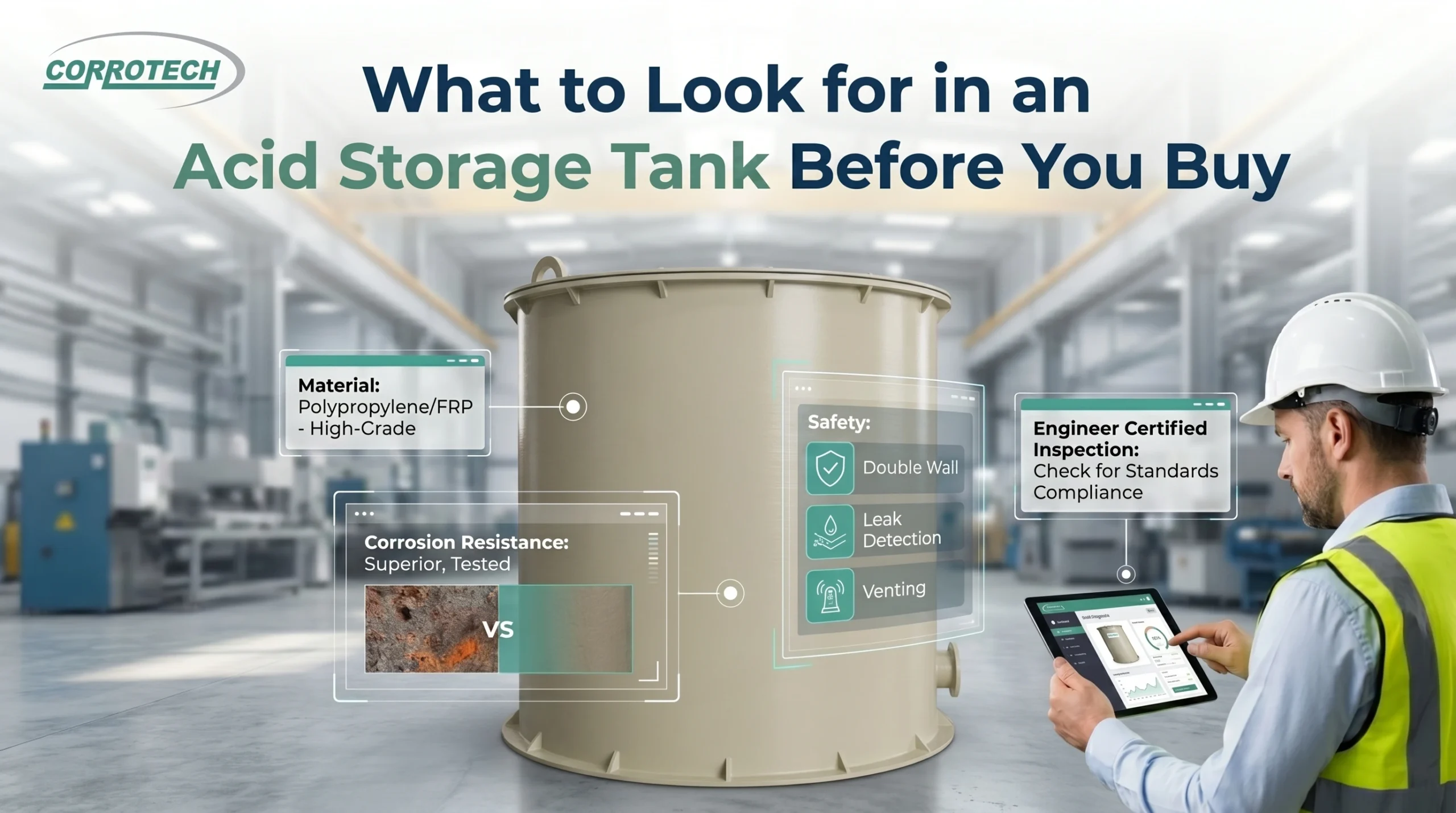
Choosing the wrong acid storage tank is more than just a purchasing mistake. It can lead to chemical leaks, equipment failure, safety hazards, environmental violations, and costly downtime on the production floor. For industries such as manufacturing, chemical processing, and water treatment, selecting the right tank requires careful evaluation beyond just the initial purchase cost.
This guide will help you understand the key factors to consider before finalizing your decision. From chemical compatibility and structural design to regulatory compliance and long-term operating costs, each aspect plays an important role in ensuring safe, reliable, and cost-effective storage.
What Exactly Is an Acid Storage Tank?
An non metalic acid storage tank is a specially built container that’s designed to safely hold corrosive acids, sulfuric acid, hydrochloric acid, nitric acid, phosphoric acid, and hydrofluoric acid in industrial quantities. It’s different from your typical chemical tank because it has to meet really tough standards for materials. The tank must be designed with durability and safety in mind. It should be capable of withstanding the highly reactive nature of acids, temperature variations, and continuous long-term operation without deterioration or failure.
These tanks are widely used across various industries, including :
- Chemical manufacturing and processing
- Water treatment and pH correction systems
- Metal pickling and surface treatment
- Fertilizer and agrochemical production
- Pharmaceutical manufacturing
- Oil and gas refining
Why This Decision Matters So Much
When an acid storage tank fails or isn’t compatible with what you’re storing, the problems go way beyond just the tank itself:
- Chemical leaks can pollute soil, contaminate groundwater, and damage everything around your facility, also a financial loss
- Tank failure can is serious and hazardous problem for your workers and the surrounding plant equipment
- Regulatory non-compliance (EPA, OSHA, IS standards) means heavy fines, plant shutdowns, and legal headaches
- Premature corrosion eats away at your bottom line through constant repairs and forces you to replace the tank way too early
The U.S. Environmental Protection Agency (EPA) has actually found that improper chemical storage is one of the biggest reasons hazardous materials get released at industrial sites. Getting your tank specification right from day one keeps your operations safe, protects your team, and keeps your compliance record clean.
Key Factors You Should Evaluate Before Buying an Acid Storage Tank
1. Material of Construction: The Most Critical Decision
Here’s the reality: your tank material has to work with the specific acid you’re storing. And we’re talking about not just the type of acid, but also how concentrated it is, what temperature it’s at, and what else might be mixed in with it.
Common Materials for Acid Storage Tanks:
| Material | Best Suited For | Key Advantage | Limitation |
| High-Density Polyethylene (HDPE) | Hydrochloric acid, dilute sulfuric acid | Lightweight, corrosion-resistant, cost-effective | Not suited for concentrated oxidizing acids |
| Polypropylene (PP) | Dilute acids, mild oxidizers | Good thermal resistance up to 80°C | Limited structural strength at high temperatures |
| Cross-Linked Polyethylene (XLPE / PVDF) | Hydrofluoric acid, aggressive acids, Nitric acid (dilute), phosphoric acid | Superior chemical resistance and stress crack resistance | Higher upfront cost |
Common Materials for Acid Storage Tanks:
Here’s the thing to remember: always use a chemical resistance chart (your material supplier, like IPEX or Ashland Chemical, can provide these) to double-check that your chosen material will work. What handles 10% sulfuric acid just fine might completely fail with 98% concentration.
2. Tank Capacity and Sizing
Get the size wrong, and you’ve got problems on both ends. Buy too big, and you’re throwing money away on capacity you’ll never use. Buy too small, and you’re stuck with bottlenecks and constantly having to refill.
Think about these things when sizing:
- What you’re using daily and what your peak demands are
- Whether you’re running batches or continuous flow
- How long does it take to get new acid from your supplier
- How much space do you actually have, and what secondary containment needs do you have
3. Design Standards and Certifications
Your acid storage tank should meet real, recognized engineering standards. When you’re talking to suppliers, make sure they can prove their tanks conform to the following:
- IS 7634 / BIS Standards (India): for polymer tanks in chemical applications
- DVS 2205 → Design calculations for thermoplastic tanks and equipment
- ASTM D1998: Standard specification for polyethylene upright storage tanks
- BS EN 13121: GRP/FRP tanks and vessels for above-ground use
- UL 142: Standard for steel aboveground tanks for flammable and combustible liquids
- OSHA 29 CFR 1910.119: Process safety management of highly hazardous chemicals
When you’re checking out suppliers, ask this directly: “Which standards is this tank certified for, and do you have third-party test certificates to back that up?”
4. Wall Thickness and Structural Integrity
Thin-walled tanks might technically meet your capacity needs on paper, but they can give out when you put them under real pressure, whether that’s the weight of dense acids, temperature changes, or a knock from equipment.
Look closely at:
- What the design standard says about minimum wall thickness (for HDPE at typical industrial sizes, you’re usually looking at 6–12 mm)
- How the ribs are arranged to reinforce the tank, and the radius where the wall meets the bottom
- Whether it’s protected from UV if it’s sitting outside
- Whether it can handle wind and earthquakes, if that applies to your location
- The difference between flat-bottom and sloped-bottom designs (sloped bottoms drain completely and clean more easily)
For bigger tanks (over 10,000 liters), definitely ask the vendor for engineering drawings and proof of hydrostatic test results.
5. Fittings, Nozzles, and Connection Points
Here’s a hard truth: your acid storage tank is only as safe as its weakest connection. Fittings that aren’t right are a major cause of leaks.
Pay attention to these fitting details:
- Material compatibility: Every fitting, flange, gasket, and bolt needs to handle the acid as well as the tank does (or better). PVDF, PTFE-lined, and polypropylene fittings show up a lot in acid work.
- Inlet and outlet positioning: Think about whether you want filling from the top (usually the safest) or draining from the bottom. Check if you need anti-siphon devices.
- Vent design: Acid fumes need to go somewhere safely. Closed venting stops vapors from escaping into your workspace.
- Level gauges and instrumentation: Chemical-resistant sight glasses or float type cut down on how much manual checking you need to do.
- Manhole or inspection access: You’ll need a way to get inside for cleaning, checking things out, and maintenance work.
6. Secondary Containment
Most countries’ regulations, plus just common sense about safety, say your acid storage tank has to be inside a secondary containment system. This backup container needs to be able to hold 110% of your tank’s volume (or if you’ve got multiple tanks, the biggest one).
You’ve got options for secondary containment:
- Integral double-wall tanks (built in at the factory)
- Containment berms or dikes (concrete or HDPE-lined)
- Containment pallets for smaller IBC/drum-scale acid storage
One important thing: whatever secondary containment you use also needs to be compatible with the acid you’re storing.
7. Temperature and Pressure Ratings
Acids don’t act the same way at all temperatures. Warm them up, and reactivity goes up, vapor pressure climbs, and the material gets stressed more.
Make sure you confirm:
- The highest temperature your material can handle during normal, continuous operation (HDPE, for example, usually tops out around 60°C for steady use)
- What temperature spikes or surges can it tolerate
- Whether your acid gets hot when you dilute it or mix it with something (exothermic reactions)
If your tank’s sitting outside in a place with big seasonal temperature swings, you might want UV-stabilized materials and insulation jackets to keep things stable.
8. Smart Monitoring and IoT Compatibility
A lot of newer acid storage setups want real-time information about what’s happening in the tank. When you’re looking at a tank, think about whether it can handle:
- IoT-integrated level sensors: for watching levels from anywhere and getting alerts if something’s wrong
- Leak detection systems: sensors in your secondary containment that sound the alarm before a spill spreads
- Predictive maintenance compatibility: data tracking for temperature, pressure, and how often you’re filling up
If you get IoT-ready fittings and sensor ports when you buy the tank, it’s way cheaper than trying to add them later on.
9. Vendor Technical Support and After-Sales Service
Buying a tank is a long-term commitment for your operation – this isn’t just a quick transaction. Evaluate your supplier on:
- Engineering support: Can they do calculations for your setup, provide installation drawings, and give you advice based on your application?
- Local service availability: Can you actually get spare parts and repair help in your area if you need it?
- Warranty terms: What do they actually cover, for how long, and under what conditions?
- Reference installations: Can they show you examples or give you contacts at other facilities in your industry?
- Lead time: Custom tanks can take 8-16 weeks. Make sure that it lines up with when you actually need it.
10. Total Cost of Ownership (TCO), Not Just Purchase Price
The sticker price is only part of the story. Here’s what actually affects your wallet over the tank’s entire life:
| Cost Factor | Impact |
| Purchase price | What you pay upfront |
| Installation and civil works | Foundations, piping, secondary containment setup |
| Maintenance and inspection frequency | Labor and materials to keep it working |
| Liner or fitting replacement | How often and how much these components cost |
| Downtime risk | What production loss costs you if the tank fails |
| Regulatory compliance costs | Permits, audits, paperwork |
| End-of-life disposal | Recycling or taking it out of service |
Here’s the thing: a tank with better specs and longer life often costs you less overall than a cheaper tank that needs replacing in 5–7 years.
11. Industry-Specific Requirements
Different industries have their own additional rules beyond the standard chemical storage guidelines:
- Pharmaceutical / food-grade applications: You need FDA/FSSAI-compliant materials, smooth inside surfaces, and nothing that could be contaminated with metal particles
- Water treatment facilities: Dosing tanks need precise, accurate fittings for small volumes
- Fertilizer production: Big outdoor tanks need construction that resists UV and can handle wind loads
- Metal finishing acid pickling tanks often need heating capability and systems to manage fumes
Make sure your supplier actually understands what you’re using the tank for, not just the specifications on the paperwork.
Common Mistakes Buyers Make When Selecting an Acid Storage Tank
Watch out for these pitfalls; they trip up a lot of purchasing decisions:
- Picking a material just because it’s the cheapest option, without checking if it actually works with your acid
- Underestimating what you’ll need in the future, then having to upgrade constantly
- Not paying enough attention to the fittings and accessories, even when the tank itself is good
- Skipping secondary containment or not treating it seriously creates real regulatory risk
- Going with a supplier that doesn’t have local support is a big problem when you need maintenance or emergency help
- Taking a supplier’s word for compliance instead of asking for actual test certificates and documentation
Acid Storage Tank Maintenance Best Practices
Keep up with maintenance, and your tank will last longer and stay safe.
- Visual inspection every 3–6 months: Look for surface crazing, color changes, or leaks at the fittings
- Pressure/hydrostatic test annually: Especially if your tank is doing critical work
- Fitting and gasket replacement every 2–3 years: Changing these before they fail stops emergencies
- Secondary containment inspection: Check for acid residue that might show small leaks
- Level sensor calibration: Test accuracy every quarter
- Vent system inspection: Make sure your scrubber media isn’t used up
Write everything down: inspections, maintenance, and repairs. You’ll need these records for regulators.
FAQS
1. What material is best for an acid storage tank?
The best material depends on the type and concentration of acid being stored. Common materials include PP, HDPE, FRP, PP FRP, and rubber-lined steel. The right material helps prevent corrosion, leakage, and chemical reactions inside the tank.
2. Why is chemical compatibility important in acid storage tanks?
Chemical compatibility is important because not every tank material can safely store every acid. Using the wrong material may cause corrosion, contamination, tank failure, or safety risks. Always check compatibility charts before buying a tank.
3. Which safety features should an acid storage tank have?
An acid storage tank should include safety features like secondary containment, proper venting systems, leak protection, pressure relief valves, and corrosion-resistant fittings. These features help reduce environmental and operational risks.
4. How do I choose the right size acid storage tank?
Tank size depends on chemical volume, daily usage, future expansion, and available installation space. Choosing the wrong size can create storage problems, operational delays, or unnecessary costs later.
5. How important is maintenance when buying an acid storage tank?
Regular inspection and maintenance are essential for long-term tank performance and safety. Buyers should check tank durability, welding quality, fittings, vent systems, and maintenance requirements before purchase.