
Tag: Chemical process tanks
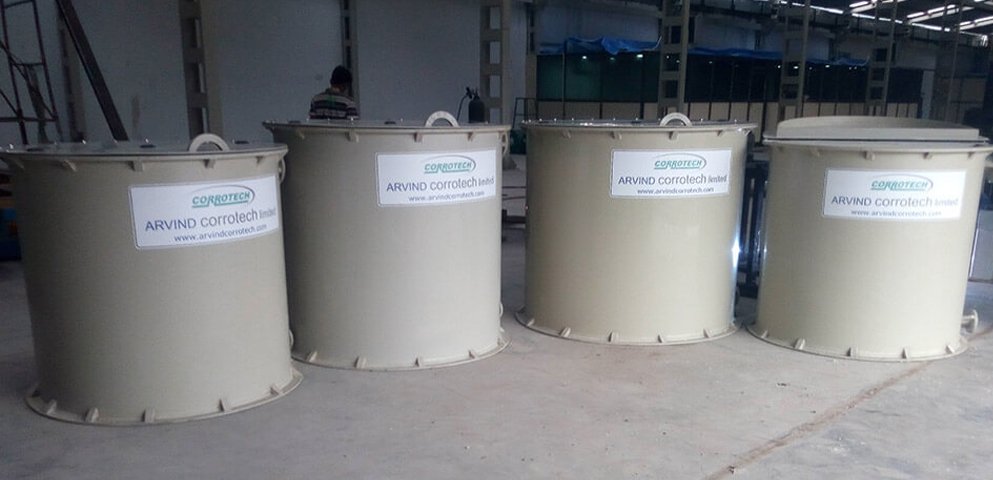
Plants that handle acids, alkalis or treatment chemicals rely on two kinds of industrial chemical tanks: those that hold chemicals until they are needed, and those where the chemistry happens.
A chemical storage tank contains a chemical at rest. A chemical process tank holds an active bath that products are dipped into, so it must also withstand immersion, heat, agitation and fumes.
Both may use the same plastics, but a tank specified for one job is rarely right for the other. Understanding chemical process tanks vs chemical storage tanks helps you avoid leaks, downtime and compliance gaps.
This guide is by Arvind Corrotech, an Ahmedabad-based manufacturer of galvanizing plants, process tanks and chemical storage tanks.
What Are Chemical Storage Tanks?
Definition and Purpose
Chemical storage tanks hold raw chemicals, intermediates or waste liquids until they are used, transferred or treated. Their job is containment: keeping an aggressive liquid in and weather and contamination out. The liquid is mostly at rest, so the main loads are the weight of the contents and, outdoors, sun and weather.
Common Materials Used
Material choice depends on the chemical, its concentration and temperature, and where the tank stands:
- Polypropylene (PP): Arvind’s polypropylene tanks use homopolymer and copolymer PP, joined by butt-fusion welding.
- High-density polyethylene (HDPE): light, non-corrosive and suited to many acids and alkalis.
- PP+FRP: a thermoplastic lining with an FRP outer skin, which Arvind uses for high temperatures and strong acids.
- FRP: for specific industrial requirements.
For acid storage tanks, Arvind recommends special polypropylene sheet inside a shed, and HDPE or UV-resistant polypropylene outdoors.
Applications and Industries Served
Chemical storage tanks commonly hold hydrochloric acid, sulphuric acid, sodium hydroxide, sodium hypochlorite, ferric chloride and wastewater awaiting treatment. Typical users include steel and galvanizing plants, chemical units, textile, leather, paper and plastics processors, and effluent treatment plants. Like other industrial storage tanks, their shape follows the site. Vertical, horizontal and square storage tanks suit different floor space, and a conical bottom lets sludge-forming chemicals drain completely.
What Are Chemical Process Tanks?
Definition and Purpose
Chemical process tanks, also called chemical processing tanks, hold a working bath in which a product is treated. Steel, wire, pipes or components are lowered in, held for a set time and lifted out.
Key Features and Specifications
Process tanks are engineered for movement, heat and fumes:
- Open-top construction, sized to the largest workpiece and the crane or hoist that loads it.
- Structural reinforcement: Arvind’s pretreatment tanks use a steel-reinforced solid polypropylene shell on support frames of FRP-coated rectangular hollow sections.
- Welding to recognised codes: Arvind states these tanks are designed to DVS 2205 and constructed to BS EN 12573, with butt-fusion welded walls.
- Heating and temperature control, for example in flux tanks.
- Fume capture, such as suction ducts along the sides and ends of Arvind’s pickling tanks.
Applications in Chemical Processing
Process tanksare the core of surface-treatment lines:
- hot dip galvanizing pretreatment;
- wire, pipe and tube pickling;
- electroplating and anodizing;
- powder-coating pretreatment;
- quench and passivation after galvanizing.
Arvind builds quench and passivation tanks, which receive hot work from the zinc kettle, in epoxy-coated mild steel.
Key Differences Between Chemical Process Tanks and Chemical Storage Tanks
| Aspect | Chemical storage tanks | Chemical process tanks |
|---|---|---|
| Main job | Contain chemicals safely over time | Treat products in an active bath |
| Typical shape | Closed vertical, horizontal or square tank with vents | Open-top rectangular tank sized to the workpiece |
| Loads | Mainly the static weight of the contents, plus weather outdoors | Contents plus immersion, crane impacts, agitation and heat |
| Temperature | Usually ambient | Often heated or temperature-controlled |
| Fumes | Vented through a controlled outlet | Extracted at the bath |
The line can blur: Arvind’s closed-top vertical tanks serve both storage and process duty. Classify a tank by what happens inside it.
Design and Construction Considerations
A storage tank is designed around the liquid, its density and its location. A process tank must also survive daily mechanical stress: heavy loads go in and out, and the walls flex as baths heat and cool. It therefore usually needs external reinforcement and carefully specified welds.
Functionality and Operational Differences
Storage tanks are filled, checked and drawn off on a schedule. Process tanks are in continuous use: chemical strength drifts, sludge builds up, temperature must stay in range, and operators work at them every shift.
Maintenance and Safety Considerations
- Storage tanks: inspect for cracks, discolouration and leaks. Keep vents clear and level gauges working, and protect outdoor tanks from UV.
- Process tanks: monitor bath chemistry and remove sludge. Inspect welds and corners where loads strike, and keep fume extraction working.
- Both: spill containment around the tank is good practice.
Our guide to inspecting chemical storage tanks goes further.
Choosing the Right Tank for Your Needs
Factors to Consider
- Capacity: size storage around your consumption between deliveries, plus a safety margin. Arvind builds acid storage tanks from 1 KL to 100 KL (company figure). Size process tanks to the largest workpiece and the line’s throughput.
- Materials: match the tank material to each chemical’s concentration and temperature, and confirm compatibility with the manufacturer.
- Regulatory compliance: in India, the Manufacture, Storage and Import of Hazardous Chemical Rules, 1989 require clear labelling of hazardous chemical containers and safety data sheets, plus safety reports and an on-site emergency plan above threshold quantities.
How to Assess Your Specific Requirements
Before requesting quotes, list each chemical with its concentration and temperature, your daily consumption or line throughput, the floor space and whether the tank sits indoors or outdoors, the loading method, fume and effluent arrangements, and the standards the tank must meet.
With those inputs, a chemical tank manufacturer can recommend the right material, shape and reinforcement. For more storage options, see our guide to different types of chemical storage tanks.
Why Choose Arvind Corrotech as Your Chemical Tank Manufacturer?
Overview of Expertise and Offerings
Arvind Corrotech builds both families of tanks, so they can be specified together:
| Range | What it covers |
|---|---|
| Chemical storage tanks | Acid, ETP, PP, HDPE and PP+FRP tanks in vertical, horizontal and square formats |
| Process tanks | Pretreatment, pickling, electroplating, phosphating, anodizing and ETP process tanks, plus accessories |
| Related systems | Effluent treatment plants and acid fume extraction |
Commitment to Quality and Customer Satisfaction
According to its About Us page, Arvind Corrotech:
- is backed by founders with more than 25 years of experience;
- operates a 10,000 square metre facility in Ahmedabad;
- holds ISO 9001:2015 certification for the design, manufacturing and supply of hot dip galvanizing plants.
Its clientele page lists more than 100 customers, including KEC International, L&T and Welspun Group. For buyers looking for a chemical storage tank manufacturer in India that also understands process lines, that combination matters.
Conclusion
Among industrial chemical tanks, storage tanks keep chemicals contained, while process tanks are working equipment built for immersion, heat, agitation and fumes. Choose by function first, then by chemical, capacity and site.
Planning new industrial storage tanks or a treatment line? Contact Arvind Corrotech with your chemicals, volumes and layout for a tailored recommendation and quotation.
Frequently Asked Questions
What is the difference between a chemical storage tank and a chemical process tank?
A chemical storage tank contains chemicals safely until they are used, with the liquid mostly at rest. Chemical process tanks, also called chemical processing tanks, hold an active bath in which products are treated, so they also need reinforcement, heat control and fume extraction.
What materials are used in chemical storage tanks?
The most common materials are polypropylene, HDPE, PP+FRP and FRP. Polypropylene suits tanks inside a shed, while HDPE or UV-resistant polypropylene is preferred outdoors. The right choice depends on the chemical, its concentration and its temperature, so check compatibility against a resistance chart and confirm it with your tank manufacturer.
How do I determine the right size for my chemical tank?
For a storage tank, size it to your consumption between deliveries, add a safety margin, and make sure it can take a full delivery. For a process tank, start from the largest workpiece, the crane or hoist that loads it, and the throughput your line needs.
What safety standards should chemical tanks meet?
It depends on the tank and the liquid. Welded thermoplastic tanks are commonly built to BS EN 12573 and designed to the German DVS 2205 code; Arvind states its pretreatment tanks follow both. Rotationally moulded polyethylene tanks are covered by ASTM D1998. In India, the hazardous chemical rules of 1989 add duties for labelling, safety data sheets and emergency plans.
Why should I choose Arvind Corrotech for my chemical tank needs?
Arvind Corrotech designs and builds both chemical storage tanks and process tanks in Ahmedabad, so storage, process lines, fume extraction and effluent treatment can come from one supplier. As a chemical storage tank manufacturer in India, it designs tanks with RITA 3 software and welds them by butt fusion to DVS technical codes.